In a world where stories cross borders before passports do, there’s a place where South Asian cinema takes center stage not just as culture, but as future. The Indian Film Festival of Los Angeles (IFFLA) is back—bigger, braver, and more beautifully interconnected than ever before.
2025 marks a cosmic expansion for IFFLA Industry Days, unfolding on May 8 and 9 at the Landmark Theatres Sunset, where narratives from India, Bangladesh, Nepal, and the South Asian diaspora meet the very core of Hollywood. And it isn’t just a festival—it’s a movement.
This year’s heartbeat? IFFLA Connect—a cinematic constellation born in collaboration with Cinévesture. It’s more than a program—it’s a bridge. A handpicked bouquet of emerging and established storytellers are set to bloom on global soil. From Radhika Apte’s directorial debut Koyta to Nuhash Humayun’s bold Moving Bangladesh, the lineup whispers revolution, reels resilience, and roars representation.
“Our focus is access,” says Noopur Sinha, Festival Producer. “These ten powerful South Asian-led projects deserve the chance to not just survive, but soar in global cinema.” And with champions like Netflix, Orion Pictures, Film Independent, Neon, and Temple Hill watching closely, the world might just listen a little more intently.
But this festival doesn’t stop at showcasing. It dares to sculpt the future. The Launchpad: Pitch Competition returns, offering five dreamers the stage, a listening industry, and a chance at $10,000 in development funding. In a room full of believers, sometimes that’s all a story needs.
Panels that Matter, Questions that Echo
The Industry Days are rich with brain and soul food:
The Human Loop panel asks: “Can storytelling stay human in the age of AI?”
Global Vision challenges studios to look beyond Western borders, diving deep into how international voices are redefining cinematic futures.
And in a heartfelt nod to literature and theatre, a panel on the Life of Pi stage adaptation explores how a tale from Pondicherry now moves hearts from Broadway to LA.
Magic has a Masterclass too.
One of the most anticipated events is “From Dhaka to Hollywood”, where South Asia’s horror whisperer Nuhash Humayun dissects how local stories can scream on global stages. From his breakout Moshari to hauntingly poetic cinema, it’s a classroom where the future listens.
The Jury that Breathes Stories
This year’s juries—both for features and shorts—are a soulful blend of insight and artistic fire:
Rajshri Deshpande, known for Sacred Games and Sexy Durga
Carla Renata, a.k.a. The Curvy Critic, whose words have shaped Variety, RogerEbert.com, and beyond
And Maureen Bharoocha, whose lens bridges genres and hearts alike.
With names like Priyanka Mattoo, Kausar Mohammed, and Sudeep Sharma in the mix, it’s clear: these are not gatekeepers—they’re gate-openers.
For the Dreamers, the Believers, and the Storytellers
IFFLA 2025 isn’t just a festival. It’s an invitation to the world to sit down, lean in, and feel the pulse of South Asia—loud, luminous, and unapologetically original. From bustling Mumbai sets to quiet Bangladeshi scripts scribbled at midnight, this is where those dreams take their first Hollywood breath.
Passes are now live at indianfilmfestival.org. And for the readers of Kulsoomified: if you’ve ever believed in the poetry of film, this is your call to witness a new chapter in the language of cinema.
I wake beneath the rusted bench, Where morning sun slips through leaves—soft, warm— And stretch my bones like old truths That still carry weight but ask no harm.
The street yawns open with honks and feet, I watch life unravel on concrete. Children run with bread in hand, One tosses a crumb—my breakfast, unplanned.
Vendors chant their daily hymns, A lady in red feeds pigeons near the temple rim. The chaiwala whistles an old film song— His cart smells of stories steeped too long.
I see a man cry near the lamp post, His suitcase shut like a locked-up ghost. He pets me gently, calls me “buddy,” His eyes spill secrets he won’t tell anybody.
I’ve seen police catch thieves, and goons running gangs, I’ve also seen protests rise like dust from marching bands. I once saw a bride walk out in rain, Laughing like sorrow had never known her name.
Monsoons flood my little square, But I dance in puddles with muddy flair. When winter bites, I curl like ink In the warm story of a shopkeeper’s wink.
They say I have no master, no home— Yet I’ve never felt entirely alone. I am painted in dust, stitched in city hum, A little wild hymn where no one comes.
Still, I stretch—tail high, heart free, This world may bruise, but it shelters me. And as the sky trades gold for gray, I keep stretching my sorrows away.
Every generation has its revolutionaries. But Dr. Bhimrao Ramji Ambedkar was more than that—he was a visionary who saw beyond his time and left behind blueprints for a just, equal, and educated world. He didn’t just fight for rights; he fought for dignity. He didn’t just write laws; he rewrote the story of India’s future.
In today’s chaotic, divided, fast-changing world, Ambedkar’s teachings feel like a compass—pointing us toward justice, courage, and collective transformation.
Here’s what we can still learn—and how it can change us.
📚 1. Education is the Ultimate Weapon
“Cultivation of mind should be the ultimate aim of human existence.”
Ambedkar’s entire life is proof that education can shatter chains. He rose from oppression to become one of the most educated men of his time, holding multiple degrees from Columbia, LSE, and more. He believed that true freedom begins in the mind.
💡 In today’s world:
In an era where misinformation spreads like wildfire and the education gap still divides rich from poor, Ambedkar’s belief reminds us to invest in knowledge, not just skills. To think critically. To learn—and to teach others.
🧘🏽♂️ 2. Self-Respect is Non-Negotiable
“I measure the progress of a community by the degree of progress which women have achieved.”
Ambedkar didn’t just fight for Dalit rights—he fought for human dignity. He believed no man, woman, or child should bow their head due to birth, caste, or gender.
💡 In today’s world:
Caste-based discrimination may have changed form but it still exists. So do racism, sexism, classism. His philosophy teaches us to stand tall, to claim our self-worth, and to question systems that try to label us lesser. From rural protests to boardroom diversity conversations—his voice still guides us.
🏛️ 3. Question Religion, Fight Injustice
“Religion is for man and not man for religion.”
Ambedkar’s powerful critique of religion wasn’t about denying spirituality—it was about rejecting systems that use it to justify inequality. His conversion to Buddhism was a radical act of choosing peace and equality over dogma and oppression.
💡 In today’s world:
With rising religious intolerance, his wisdom reminds us to separate faith from fanaticism. To choose compassion over ritual. And to create a society where religion heals, not hurts.
📜 4. Build Institutions, Not Just Movements
As the architect of the Indian Constitution, Ambedkar created structures that protected the rights of all citizens. He didn’t just revolt—he rebuilt.
💡 In today’s world:
Activism today needs more than protests—it needs plans, policies, and perseverance. Whether you’re fighting climate change, casteism, or corruption—build things that last. Create change that outlives you. Like he did.
🔥 5. Be Unapologetically Brave
“Life should be great rather than long.”
Ambedkar was never afraid to speak truth to power, even when it cost him approval, position, or peace. He didn’t wait for permission to fight for what was right.
💡 In today’s world:
His spirit lives on in every girl who dares to dream beyond what her village told her, every queer youth demanding visibility, every worker organizing for fair wages. Being Ambedkarite today means being bold, not bitter—and taking the road less safe but more just.
🌍 Final Thoughts: Ambedkar is Not Just History—He’s the Future
If you’re looking for a hero who wore no cape, spoke truth like fire, and dreamed of a world where every human is treated as human—Dr. B.R. Ambedkar is not just a chapter in your textbook. He is a mirror, a map, and a mantra for our times.
To walk in his footsteps doesn’t mean being perfect. It means being awake. Being aware. Being active.
Because the India Ambedkar dreamed of? It’s still being built. And we are the builders now.
As mid-April blossoms into Pohela Boishakh, Baisakhi, and Ambedkar Jayanti, we witness not just seasonal or cultural shifts—but spiritual reminders. These dates mark beginnings, harvests, revolutions of identity, and the dignity of selfhood. What better moment to revisit the deeply personal and profoundly political verses of the Bhakti Movement?
The Bhakti saints spoke in simple tongues, but their words had the weight of mountains. They shattered caste walls, defied societal norms, and chose poetry as their protest and prayer.
These poems weren’t written for scholars. They were written for people like us—soulful, weary, hopeful. And yes, they still speak.
1. Mirabai – The Lover Devotee of Krishna
Picture Source : Wikipedia
Poem: “Mere to Giridhar Gopal, doosro na koi, Jaake sir mor mukut, mero pati soi.”
Meaning: “My only beloved is Giridhar Gopal (Krishna), I belong to none else. The one who wears the peacock feather crown—that alone is my husband.”
Why it resonates today:
Mirabai’s defiance of patriarchal norms mirrors the journeys of modern women choosing self-love over societal pressure, or standing by partners and dreams that the world may not approve of. Her devotion is echoed in every woman choosing authenticity over conformity. In interfaith relationships, LGBTQ+ love, and bold artistic self-expression—Mira still sings.
2. Kabir – The Weaver of Eternal Truths
Picture Source: artofit.org
Poem: “Bura jo dekhan main chala, bura na milya koi, Jo man khoja aapna, mujhse bura na koi.”
Meaning: “I went out to find evil in others, but found none. When I looked within myself, I realized none was worse than me.”
Why it resonates today:
In a digital age full of cancel culture, online outrage, and blaming others for everything—from politics to personal woes—Kabir reminds us to turn inward. This poem is a guide to emotional maturity and self-awareness. It’s a timeless push toward introspection over judgment.
3. Tukaram – The Farmer Mystic
Picture Source: Pinterest
Poem: “Pandharicha mahatva kon jane re, Techi jane jyancha bhaktichya bhare.”
Meaning: “Who truly knows the greatness of Pandharpur? Only those drenched in the flood of devotion.”
Why it resonates today:
Tukaram’s poetry connects deeply with today’s grassroots voices, farmers’ protests, and simple folk whose faith is their survival. His verses still sing in every rural home where belief and struggle live side by side. In a world that often ignores the rural, the underpaid, and the overlooked—Tukaram remains a voice of dignity.
Meaning: “This is the auspicious month of Margazhi, lit with moonlight. Come, let us bathe and celebrate together!”
Why it resonates today:
Andal’s poetry feels like a call to collective feminine joy. In today’s world of sisterhood circles, girlhood revivals, women’s retreats, and sacred feminine movements, her invitation to spiritually bathe together is an ancient version of modern self-care, sisterhood, and divine femininity.
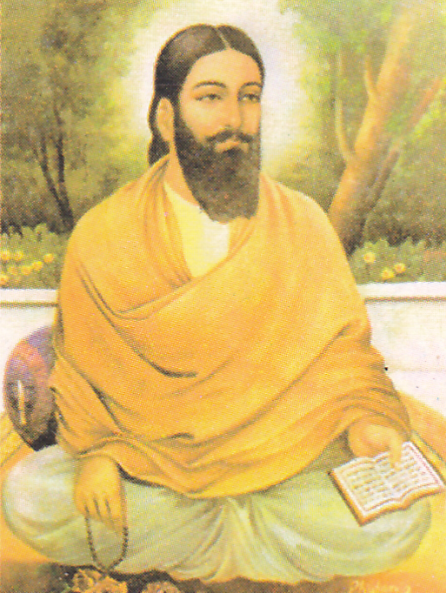
5. Ravidas – The Voice of Equality
Picture Source : Indian Postal Stamp, Wikipedia
Poem: “Begampura sheher ka naam, dukh andohu nahi jisme dham.”
Meaning: “The name of the city is Begampura— A city with no sorrow or suffering.”
Why it resonates today:
This verse is an anthem for every activist, every oppressed voice, and every dreamer of justice. It resonates during Ambedkar Jayanti when India remembers the long fight for equality. Ravidas’s “Begampura” is today’s utopia—where caste, class, and gender don’t define opportunity. It lives in protests, in policy demands, and in people who still believe a better world is possible.
So, Why Now?
Because we are once again in a time where:
Love is politicized.
Faith is divided.
Women are questioning roles.
The marginalized are rising.
And amidst the noise, the soul still longs for truth and tenderness.
These verses are not just relics—they are resonances. They live in:
A girl posting poetry on Instagram about heartbreak and the cosmos.
A Dalit student topping civil services.
A farmer holding onto faith during floods.
Endnote: Bhakti is not Blind
Bhakti is not about superstition or subservience. It is about devotion as power. It is about surrender—not to oppression, but to truth, love, and purpose.
This Pohela Boishakh, Baisakhi, and Ambedkar Jayanti, let us not only light lamps and wear new clothes— Let us light a fire of poetry inside. Let us listen to voices that refused to stay quiet, even centuries ago.
Because maybe, in the quiet of your heart, Mirabai still weeps. Kabir still questions. Ravidas still dreams. Andal still sings. And you, dear reader, still feel.
India is a land of linguistic diversity, with over 19,500 languages and dialects spoken across the country. Given this rich multilingual heritage, education systems in India must embrace and integrate multiple languages to ensure inclusive and effective learning. Multilingual education is not just a pedagogical choice but a necessity in a country where language plays a crucial role in identity, culture, and communication.
Understanding Multilingual Education
Multilingual education refers to the use of two or more languages in teaching and learning processes. In India, this is often implemented through a combination of the mother tongue, regional language, Hindi, and English. The National Education Policy (NEP) 2020 has reinforced the importance of multilingualism, advocating for instruction in the mother tongue at least until Grade 5, and preferably until Grade 8.
Benefits of Multilingual Education in India
1. Strengthens Cognitive Development
Children who learn in multiple languages develop stronger cognitive abilities, including better problem-solving skills, creativity, and adaptability. Studies show that multilingual individuals tend to have enhanced memory retention and mental flexibility.
2. Improves Learning Outcomes
When students are taught in their mother tongue during early education, they grasp concepts more effectively. Research indicates that children learning in their native language perform better in subjects like mathematics and science compared to those who are taught in an unfamiliar language.
3. Preserves Cultural and Linguistic Heritage
Multilingual education helps preserve India’s linguistic diversity by ensuring that regional and tribal languages continue to thrive. It prevents language extinction and fosters a deeper appreciation for India’s rich cultural heritage.
4. Enhances Social Inclusion
Many students, especially from rural and tribal areas, struggle with mainstream education because they are taught in a language unfamiliar to them. Multilingual education promotes inclusivity by ensuring that children from diverse linguistic backgrounds have equal access to quality education.
5. Increases Employment Opportunities
In a globalized world, proficiency in multiple languages opens up better job opportunities. Knowledge of English, along with regional and foreign languages, makes individuals more competitive in national and international markets.
6. Strengthens National Unity
India’s linguistic diversity is often seen as a challenge, but multilingual education can turn it into an asset. Encouraging students to learn multiple Indian languages fosters mutual understanding, reduces language-based discrimination, and strengthens national unity.
Challenges in Implementing Multilingual Education
Despite its advantages, multilingual education in India faces several challenges:
Shortage of trained teachers proficient in multiple languages.
Lack of quality educational materials in regional and tribal languages.
Resistance to change, with many parents preferring English as the medium of instruction.
Administrative hurdles in standardizing multilingual curricula across states.
Way Forward
To fully harness the benefits of multilingual education, India needs:
More teacher training programs focusing on multilingual instruction.
Investment in developing textbooks and digital resources in various languages.
Public awareness campaigns to educate parents on the benefits of mother-tongue-based learning.
Policy implementation and monitoring to ensure effective execution of NEP 2020’s multilingual approach.
Conclusion
Multilingual education is vital for India’s future, as it enhances learning, promotes inclusivity, and preserves cultural heritage. By embracing linguistic diversity in education, India can build a more knowledgeable, united, and globally competitive society. With proper implementation and awareness, multilingual education can become a powerful tool for national development, ensuring that every child, regardless of their linguistic background, receives an equitable and enriching learning experience.
The primary function of political cartoons is to offer political commentary on current affairs and societal issues. Furthermore, cartoonists frequently view their creations as a weapon against the misuse of authority. They therefore want to discredit and expose the powerful. The outcome is frequently unexpected but not always humorous. In a country that is as culturally and politically diverse as India, cartoons can be a medium to educate the people as due to uneven distribution of resources, not everyone has the same access to information and education as each other.
Cartoonists sketch a unique and powerful story by combining wit, humor, and social commentary in their creations. From magazine pages to television, these masters of the pen use their artistic skills to entertain audiences and spark imaginations. Let’s take a look through the corridors of creativity and explore the works of some of India’s most famous cartoonists.
Father of Political Cartooning in India – Kesava Shankar Pillai (31 July 1902 – 26 December 1989)
Indian cartoonist Kesava Shankar Pillai (31 July 1902 – 26 December 1989), popularly known as Shankar, was born. In India, he is regarded as the founder of political cartooning. In 1948, he started Shankar’s Weekly, the Punch of India.
{Cartoonists Abu Abraham (above) and Kutty (below)}
Cartoonists such Abu Abraham, Ranga, and Kutty were also produced by Shankar’s Weekly; however, the publication was shut down on June 25, 1975, due to an emergency. He then focused on helping kids laugh and have fun with life. In 1976, the Indian government bestowed upon him the second-highest civilian decoration, the Padma Vibhushan.
{The collection of costume dolls in the museum was inspired by a gift of a single doll that Shankar received from the Hungarian Ambassador in the early fifties. (International Doll Museum, Delhi)}
He is best known today for founding Shankar’s International Dolls Museum in 1965 and the Children’s Book Trust, which was founded in 1957.Shankar’s caricatures appeared in The Bombay Chronicle and The Free Press Journal. He was hired as a staff cartoonist by Pothan Joseph, the editor of the Hindustan Times, in 1932, and remained on staff until 1946.
Shankar was able to train in London for almost fourteen months. He studied advanced cartooning methods during that time by attending numerous art schools. He also travelled to Paris, Geneva, Vienna, Berlin, and Rome.
India was in the throes of an independence movement when he returned. Shankar’s aspirations for an independent publication were also supported by the onset of freedom. When Pandit Jawaharlal Nehru published Shankar’s Weekly, which Shankar edited himself, the concept was realised.Shankar was organised and adored children. The Shankar’s International Children’s Competition was founded by Shankar in 1949, and the Shankar’s On-the-Spot Painting Competition for Children was a part of it in 1952. In 1978, he started an annual competition for children’s book writers. This tournament, which started in English, is currently being held in Hindi as well.
‘A Symphony of Dreams’ was an exhibition held at the Lalit Kala Academy in Delhi in 2002 to mark the centennial of his birth. He drew a cartoon of Bhimrao Ambedkar in 1949, and when it was included in NCERT educational materials, it created “furor” in the Indian Parliament. As a result, concerned NCERT staff members resigned in May 2012. People who identified as “Republican Panthers” demonstrated against the cartoon. The Kerala Lalithakala Akademi created the Shankar Memorial National Cartoon Museum and Art Gallery in 2014 as a memorial to the well-known Indian cartoonist in his homeland.
A Not-So-Common Man – R.K. Laxman (1921-2015)
Rasipuram Krishnaswami Iyer Laxman was an Indian humorist, illustrator, and cartoonist who lived from 24 October 1921 to 26 January 2015. The Common Man, which he created, and You Said It, a daily comic strip that he launched in 1951 in The Times of India, are his most well-known works.
{In Photo: R.K. Laxman and R.K. Narayan}
In 1921, a Tamil Hindu Brahmin family welcomed R. K. Laxman into the world in Mysore. Laxman was the youngest of eight children—six sons and two daughters—and his father was a headmaster. The well-known novelist R.K. Narayan was his older brother. “Pied Piper of Delhi” was the moniker given to Laxman’s elder brother.
Early work by R.K. Laxman was published in magazines such as Swarajya and Blitz, as well as newspapers Rohan. also started drawing political cartoons for the Swatantra and local newspapers, and also illustrated stories written by his older brother R. K. Narayan for The Hindu while he was still a student at the Maharaja College of Mysore.
{ SAB TV aired an Indian comedy series called R. K. Laxman Ki Duniya(2011-2013). The famed cartoonist R. K. Laxman’s work served as the inspiration for it. The focus of the show was on the pleasures and sufferings of the average man.}
Additionally, Laxman created cartoons for Koravanji, a Kannada humour magazine started in 1942 by M. Shivaram, a physician with a clinic in Bangalore’s Majestic neighbourhood. When he first established this monthly journal, he focused on cartoons and stories that were lighthearted and satirical. In Kannada, Shivaram was a well-known humorist. He encouraged Laxman.
{The R. K. Laxman Museum is a single-artist museum located in the Balewadi area of Pune, Maharashtra. It was inaugurated in 2022.}
Laxman worked as a summer employee at the Madras Gemini Studios. His first permanent position was as a political cartoonist for The Free Press Journal in Mumbai, where he worked alongside Bal Thackeray. Laxman started working for The Times of India, Mumbai, in 1951, and he stayed there for more than fifty years. In his pocket comics, his “Common Man” persona is presented as a witness to the emergence of democracy.
Not Your Local Cartoonist – Mario Miranda (1926-2011)
Mario Miranda, also called Mario de Miranda, was an Indian painter and cartoonist who was headquartered in Loutolim, in the Indian state of Goa. He was born Mário João Carlos do Rosário de Brito Miranda on May 2, 1926, and passed away on December 11, 2011.
Miranda gained prominence via his writings published in The Illustrated Weekly of India, but he was also a regular contributor to The Times of India and other Mumbai newspapers, such as The Economic Times. In 2012, he received the Padma Vibhushan, India’s second-highest civilian honour, posthumously.
{15th August, 1988 “Mile Sur Mera Tumhara” on Doordarshan- a song that showed India’s diversity and was created on the theme Unity in Diversity}
Miranda appeared in the 1988 “Mile Sur Mera Tumhara” national integration video, which also starred a number of well-known Indian artists, writers, musicians, and athletes. He received the Padma Shri in 1988, the Padma Bhushan in 2002, and a lifetime achievement award from the All India Cartoonists’ Association in Bangalore. On November 11, 2009, Don Miguel Nieto Sandoval, a tourism adviser, gave Mario the highest civilian accolade, the “Cross of the Order of Isabel the Catholic,” bestowed by King Juan Carlos of Spain at his family’s Loutulim residence. On December 29, 2009, he was appointed “Commander of the Order of Prince Henry,” a Portuguese National Order of chivalry, by President of the Republic Aníbal Cavaco Silva.
{Mario’s Mural on the streets of Goa, Maharashtra}
In March 2012, the Goa Legislative Assembly mentioned him in an obituary following his death in 2011. Miranda was honoured with the 2013 naming of a Mumbai Road intersection. On the occasion of his 90th birthday, Google celebrated him with a doodle in May 2016. The doodle depicted a typical rainy-season neighbourhood scene in Mumbai.
{Aaron Renier – an American Comic Artist and Author (famous for his comic “The Unshrinkable Walker Beam”), and the guy who created Google Doodle for Mario Miranda}
— Aaron Renier (he/him/his) (@acornreindeer) May 2, 2016
{2016 Google Doodle by Aaron Renier}
As per Aaron Renier’s Google Doodle, which was made in honour of Miranda on his 90th birthday in 2016, Miranda’s most favoured cartooning style was “very flat with criss-crossing interactions”. Renier continued by explaining: That is what I liked most about his work. Trying to pick out who knows who, who’s watching who, who’s annoyed by who, who’s enamoured by who. (Source: Wikipedia)
No Prime Minister – Sudhir Tailang (1960-2016)
Tailang was born on February 26, 1960, in Bikaner, Rajasthan, and died of cancer in 2016.Tailang’s childhood fascination with comics like Tintin, Phantom and Blondie is said to have inspired him to pursue cartooning.
In 1970, at the age of ten, he got his first cartoon published in a newspaper.Tailang began his career in 1982 with the Illustrated Weekly of India, Mumbai, after creating his first cartoon in 1970. He began working in Delhi for the Navbharat Times in 1983. He worked for the Hindustan Times for a number of years, taking brief breaks to also work for the Indian Express and The Times of India. The Asian Age was his most recent assignment.
He received the Padma Shri in Literature and Education in 2004. Several politicians were the targets of his caricatures as a cartoonist, including Manmohan Singh, Rajiv Gandhi, Atal Behari Vajpayee, P V Narasimha Rao, Indira Gandhi, and Narendra Modi. His cartoons on Manmohan Singh during his first term as prime minister were included in the book “No, Prime Minister,” which he released in 2009.
Political Cartooning to Politics – Balasaheb Thackeray (23 January 1926 – 17 November 2012)
The famously known Bal Keshav Thackeray, also referred to as Balasaheb Thackeray, well as the creator of the Shiv Sena political organisation. However, he was a multi-talented man, and one of them was cartooning. He began his professional career with The Free Press Journal, but he soon left to start ‘Marmik’, a political weekly of his own. His drawings supported his protests against Mumbai’s growing non-Marathi population. Alert on his end, he rendered every detail with detailed drawings.
On June 19, 1966, Thackeray founded the Shiv Sena as a result of Marmik’s success. Aside from that, his writings mirrored and emphasised the growth in poverty, price increases, and even pressing problems like riots and the subsequent expansion of the nation’s armaments trade. The master of cartooning departed from this life in 2012.
Conclusion
As we draw the curtains on this exploration of India’s rich culture of Political cartooning in India, it becomes evident that their legacy extends far beyond the strokes of their pens. By reflecting the many dimensions of Indian society through their artistic expression, these artists have not only amused but also educated audiences and sparked thought-provoking conversations. As we honour their accomplishments, let’s not forget that a single cartoon’s ability to spark debate and motivate action is evidence of the lasting value of this distinctive form of visual expression. The ink may run in the dynamic field of Indian cartooning, but the influence of these forward-thinking artists will last for many years.
Note: Please note that the images used in this article are from across the web and this blog does not hold the copyright to these images.
Let us know if such articles are of your interests. This Blog is forever open to suggestions, views, and discussions.
It might be difficult to strike the ideal mix between style and functionality when you’re a busy mum. Nonetheless, adopting the bohemian style trend can provide a novel approach. Boho clothing seamlessly combines elegance and comfort with its laid-back yet trendy design, making it a great option for working mothers.
Here are five stylish boho looks to take into consideration if you’re ready to add some bohemian flair to your wardrobe:
Flowy Maxi Dresses
Wear flowy maxi dresses to embrace the carefree vibe of bohemian style. These floor-length beauties radiate bohemian flair and provide the utmost in comfort. To harness those boho vibes, go for earthy tones, floral prints, or ethnic patterns. Wear with sandals or ankle boots for a casually stylish outfit that works well for everything from school runs to brunch dates.
Accents of Tassels and Layered Fringe
Layered fringe and tassel accessories give your ensembles a whimsical twist. These whimsical accents, like a bold necklace, a kimono with fringe, or a purse with tassels, can quickly update your appearance. They’re ideal for bringing movement and texture to your ensemble, which will effortlessly create a fun and fashionable bohemian vibe.
Embroidered Tops and Blouses
Wear embroidered tops and blouses to embrace the bohemian fashion artistry. These tops infuse your wardrobe with a touch of workmanship, whether they are elaborate ethnic motifs or delicate floral embroidery. For a carefree daytime appearance, pair them with jeans or shorts; alternatively, dress them up with a long skirt and bold jewellery for a bohemian-chic nighttime combination.
Wide-Legged Palazzo Trousers
Breathable and comfortable, wide-legged palazzo trousers are the perfect alternative to constricting narrow jeans. These flowy trousers let you move freely and appear effortlessly stylish at the same time. They are both stylish and functional. To create a well-proportioned silhouette that’s ideal for running errands or meeting friends for coffee, pair them with a cropped blouse or a fitted tank top.
Items with a Vintage Feel
To round off your bohemian attire, incorporate items with a Vintage feel that infuse your ensemble with nostalgia. Imagine hefty jewellery with a nostalgic feel, floppy hats, woven straw bags, and large sunglasses. These accessories not only improve your ensemble but also give it a distinctively personal touch that makes it truly you.
Embracing bohemian design into your daily wardrobe as a working mother doesn’t have to be difficult. Flowing silhouettes, fun accents, and accessories with a vintage vibe will help you to effortlessly update your style without sacrificing functionality. So go ahead and embrace the stylish and carefree vibe of boho fashion by letting your inner bohemian goddess out!
Note: All the Images of this blog is taken from Pinterest.












Leave a Reply